
Did you know the lifespan and health of young trees is impacted by how you plant it?
We’ve put together some tips for how to plant a young tree so as to give it the best chance at thriving.
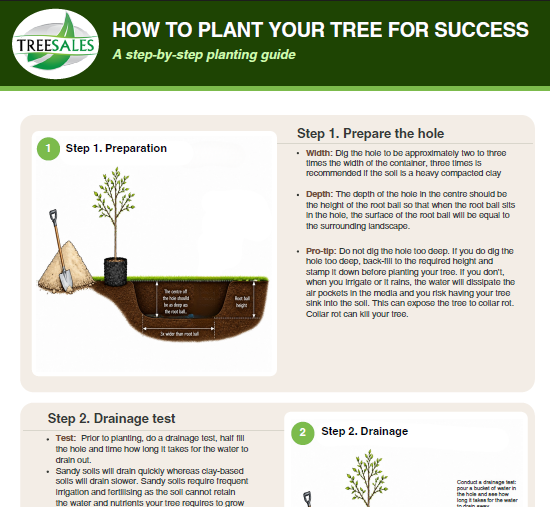
A sample of what you will find in our planting guide.
Dig the correct hole size
Width - We recommend that the hole should be approximately two to three times the width of the container, if your soil is a heavy clay we suggest the hole should be at least three times the size of the container. If your soil is a heavy clay, we would also recommend back filling with a combination of the existing clay soil and an organic compost mixed together. This creates an aerated gradation between the potted soil and the clay of the surrounding ground to allow the roots to establish into the landscape.
Shape - When digging your hole shape it like a wok with the deepest part being the centre where the plant is being placed. Most tree roots are located within the first 300-400mm of the soils surface due to the supply of air and water essential for the development of your roots.
Depth - The depth of the hole should be the depth of your container so that when the root ball sits in the hole the surface of the root ball will be equal to the surrounding surface soil. Do not dig the hole too deep. If you do dig the hole too deep, back fill but ensure that you stamp the soil down before planting the tree. This is due to the aeration within the soil, if you don't stamp it down when you irrigate or it rains the water will dissipate the air pockets in the media and your tree can sink. If your tree sinks or you plant it too deeply then you expose the tree to collar rot and this can kill your tree.
Drainage Test
Prior to planting we recommend that you do a drainage test. Essentially once you have dug your hole place a bucket of water into the hole (if you have a small plant then only a quarter to half a bucket may be necessary). Monitor the water level to see how long it takes to drain, sandy soils will drain very quickly and soils with a clay component will drain gradually. What we want you to be aware of though is that the water fully drains within 24 hours, if it has not then anything you plant is at risk of root rot and this can kill your tree.
Sandy soils allow for aeration and the establishment of roots within the soil but can't retain water and fertiliser, therefore you need to monitor your trees to ensure that they have adequate access to water and nutrients to aid in their growth and survival.
Clay based soils retain water and nutrients but issues with aeration can result in the the roots of trees struggling to establish in the landscape. You also need to be careful not to over-water your trees, some people make the mistake that if their tree is wilting or looking in distress that it must need more water, when it could be the reverse. To make a decision we recommend sticking your finger into the root ball and seeing how wet it feels. If it's very wet then you don't need to water, if it feels dry then watering may likely be necessary.
Planting the tree
Position the tree, and back fill the hole with the existing soil, (remembering to mix in compost if your ground is heavy clay - we'd recommend a 50/50 mix). Break the soil down in your hands as it is placed back in the hole to provide the air pockets essential for the tree roots to establish in. To determine if your tree is planted correctly the top of the root ball should be even with the landscape that it is planted in. Do not cover the top of the root ball with dirt.
Make sure the tree is straight then stake from both sides. Keep the ties firm but not over tight. You will want the tree to be able to flex a little as it grows to strengthen the trunk in preparation for when it no longer needs stakes. Staking is important, never hard stake against the trunk when planting into the landscape. Staking either side allows the tree to move when exposed to wind but in a storm it protects the tree from rocking too aggressively in the ground and breaking the fibrous roots. If the fibrous roots break, then you can inhibit the growth of your tree.
Staking in this way also aids in the establishment of the root plate, through the exposure to wind the tree is able to establish its structural root plate to brace itself against strong winds, trees that are hard staked to the trunk are unable to establish this structural root plate efficiently and are at a heightened risk of whole tree failure in storm events.
Mulching
Mulch around the tree, the area to be covered will be consistent with the area that was dug out to plant the tree.
The height of the mulch should be approx. 100-150mm, create a basin wall around the root ball with the mulch to act as a water basin.
Leave the root ball free of mulch and do not mulch or apply any material (i.e. lawn clippings) directly around the trunk of the tree as this can also risk the development of collar rot developing.
Water your tree
Check trees regularly, and when watering ensure that the mulch is away from the trunk of the tree.
Adjust your watering frequency according to your soil moisture. Check soil moisture by probing the soil around your trees, for juvenile trees we suggest sticking your finger into your root ball, how does it feel? If it feels wet and cool then your tree should be fine and doesn’t need supplemental water, if it feels warmer and dry then firstly check to see if rain is anticipated soon, if it is then depending on the rainfall anticipated, you may be able to let Mother Nature water your tree. If the predicted rainfall is low, then supplemental watering would be recommended.
For semi-mature to mature trees the area to be inspected is larger and if you can’t get your finger into the soil you can use either a screwdriver or soil probe. If it penetrates easily and brings up moist soil, you can extend the time between waterings. If it's difficult to push in and comes up dry, your trees still need supplemental water but again check firstly to see if any rain is anticipated and in what volume, and then decide from there if you need to water your trees.